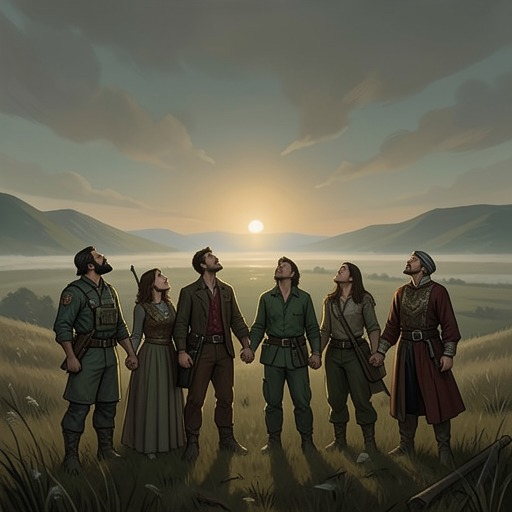
Kaladin's Survival of the Highstorm
The Way of KingsKaladin's Survival of the Highstorm is the turning point in which a punishment designed to kill Kaladin fails. After being tied by his ankles to the slanted roof of Bridge Four's barrack, he is left exposed to the approaching highstorm, already injured and disoriented. The storm tears at his body, an uncanny face appears in the darkness, and the bridgemen later find what seems to be his corpse. His sudden return to consciousness transforms the scene from an execution into a survival that alters how his comrades understand him and how the narrative measures the power of the bridge system over an individual life.
Punishment Within the Bridge System
The ordeal grows out of a military order in which bridgemen are treated as expendable equipment rather than soldiers whose survival matters. A lagging bridgeman can be whipped, assigned extra work, have his pay docked, or be tied to a post or wall to face a highstorm. Yet the army reserves direct execution for one particular offense: refusing to charge the Parshendi. The rule produces a vicious trap. Charging with a bridge may kill a man, but refusing to run guarantees death.
Kaladin has already been marked by that system. His forehead bears three brands: the first two form the glyph-pair imposed on him eight months earlier, on his last day in Amaram's army, while the third is fresh and reads Shash, meaning dangerous. Even in slavery, his history of escape distinguishes him from the other prisoners. A timid slave approaches him because he has heard that Kaladin has escaped before, and the exchange makes visible the reputation that survives beneath the brands and the rags.
The punishment at the barrack is therefore both physical and public. Kaladin has seen it happen to other bridgemen who committed murder or repeatedly stole, and he recognizes the arrangement immediately: his ankles are tied to a rope fixed to a ring in the roof, his back is against the fifteen-foot Soulcast building, and his arms hang toward the ground. The posture makes his body an object displayed for destruction, while the rope converts the barrack into an improvised execution site.
The Stormwall and the Ordeal
Kaladin faces the storm while concussed, with several ribs probably cracked or broken, a swollen eye, and possible damage to his collarbone. He wants to remain conscious and look directly at the highstorm, though the approaching darkness produces the same panic he felt when he once looked into the Honor Chasm. In the chasm, at least, there had been a possible line of retreat. Here the eastern edge of the warcamp has been worn away, Bridge Four's barrack stands first in the row, and nothing separates him from the storm.
The stormwall arrives as a gigantic curtain of rain and wind, a wave of water, dirt, and rocks hundreds of feet high, preceded by thousands of windspren. Its violence strips away any illusion that Kaladin can master the situation through skill or strength. The initial blast nearly knocks him unconscious; cold water and debris hammer the stone around him, while the force presses him against the barrack. When the stormwall passes, the wind changes direction and flings him sideways and upward. The rope catches him, leaving him flapping against the roof like a kite.
The rope is at once the instrument of his punishment and the thing that prevents his death. Without it, the storm would carry him with the debris across Roshar. His fear becomes intensely bodily: panic boils from his chest, cold tries to freeze him from the skin inward, and the wind, water, thunder, and lightning reduce thought to immediate endurance. He clutches the single sphere he possesses as if it were a lifeline, but the scene offers no ordinary rescue. Survival depends on the same restraint meant to keep him suspended for execution.
The Face in the Darkness
At the height of the storm, the scene shifts from natural terror to an encounter that remains unexplained within the immediate event. After the worst of the winds, Kaladin stands on the slick, gently sloped roof without feeling his wounds. The silence seems physically weighted, and the air itself appears lighter, as if he might float away. Then an enormous black face forms directly before him.
The face is inhuman, wide as a thunderhead, faintly traced in the darkness, and smiling. Its scale makes Kaladin seem insignificant, while its sudden appearance interrupts the otherwise material description of rain, stone, rope, and shattered debris. The sphere in his hand flares with sapphire light, revealing his torn shirt, lacerated skin, and the blue fire of his fist. When he looks back toward the face, it has vanished, leaving only darkness.
The moment is important not because the event supplies a full explanation, but because it places Kaladin's physical survival beside an encounter that exceeds his understanding. Earlier, Syl had spoken as if she remembered watching him fight before she began following him, a claim that Kaladin recognizes as strange because she had acted like an ordinary windspren during that earlier period. The highstorm ordeal thus occurs within a growing pattern of uncertain memory and uncanny attention, without resolving what the face means.
Apparent Death and Reversal
When the storm passes, the other bridgemen gather around the hanging body. Kaladin's wounds make him appear to be slaughterhouse meat: his skin is cut in countless places, blood mingles with rainwater, his shirt has been torn away, and his trousers are ragged. Teft, accustomed to battlefield corpses, sees a dead young man. The group is quiet and horrified, and Teft's reaction shows how completely the punishment seems to have achieved its intended result.
The reversal comes when Kaladin's eyes snap open. The bridgemen gasp; some curse and fall into pools of rainwater. Kaladin draws a ragged breath, wheezes, and stares forward with an intense but unseeing expression before exhaling bloody spittle. The return is not triumphant or clean. His body remains damaged, his consciousness is impaired, and the physical signs of death still dominate the scene. Nevertheless, the movement from apparent corpse to living man changes the meaning of everything that came before.
The sphere Teft gave him slips from Kaladin's opening hand and lands in a puddle, its Stormlight gone. That extinguished light gives the ending a stark final image: Kaladin survives without the visible aid of the object he treated as a lifeline, while the bridgemen witness a man whom the system had already counted as dead. The event leaves survival itself as the fact that cannot be absorbed into the army's intended order.
Narrative Significance
The highstorm punishment concentrates the book's recurring opposition between institutional expendability and individual endurance. The bridge army defines a bridgeman through replaceability, brands, punishment, and obedience; the storm makes that violence literal by exposing a single body to forces no soldier can command. Kaladin's survival does not erase the system's brutality. Instead, it reveals the system's failure to control the meaning of his body: the same body marked as dangerous, used as equipment, and displayed for execution becomes the body through which the other bridgemen encounter an impossible reprieve.
The event also converts an inward crisis into a witnessed transformation. At the Honor Chasm, Kaladin had approached the edge after being haunted by the bleeding eyes of an unnamed boy and unable to accept another death like it. The chasm offered the bridgemen their last supposedly honorable choice, death, and the broken landscape seemed to break the people sent into it. At the barrack, Kaladin again confronts the fear of an unseen end, but this time he cannot choose the manner of his death. He is forced to endure the storm, and the result is a reversal witnessed by Bridge Four rather than a private disappearance into darkness.
In plot terms, the scene combines execution, ordeal, and escape from an apparently final fate. Its reversal is sharpened by the gap between expectation and result: everyone expects the rope and highstorm to produce a corpse, yet Kaladin returns to consciousness after the witnesses have accepted his death. The event therefore does more than preserve his life. It makes survival a rupture in the logic that has governed him since his fall from Amaram's army, while the smiling face and the depleted sphere ensure that the rupture remains mysterious as well as physical.